Muslim personal law board opposes Supreme Court petition that seeks to end polygamy

Hindustan Times, New Delhi | By
Published on: Jan 27, 2020 12:35 pm IST

The petitioner Ashwini Kumar Upadhyay submitted that polygamy violates Section 494 of Indian Penal Code which prohibits bigamy and nikah halala amounts to rape under Section 375 of IPC.

The All India Muslim Personal Law Board (AIMPLB) has moved Supreme Court to make them party in the case where the bench led by Chief Justice of India (CJI) is hearing a Public Interest Litigation (PIL) against the petition challenging Islamic practices of polygamy and nikah halala.
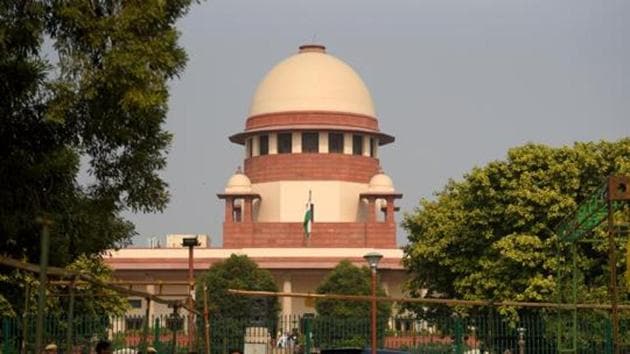
The petitino is being heard by a bench headed by Chief Justice of India (CJI) SA Bobde.(Amal KS/HT Photo)

The AIMPLB told the Supreme Court on Monday that the issue was already settled in a 1997 judgment and personal laws cannot be tested for violation of fundamental rights.

In 1997, the Supreme Court had refused to interfere with the practice of polygamy saying the matter was a policy decision and the courts should not interfere.

The petitioner Ashwini Kumar Upadhyay submitted that polygamy violates Section 494 of Indian Penal Code which prohibits bigamy and nikah halala amounts to rape under Section 375 of IPC.

The petitioner submitted that religious leaders, imams, maulvis, who propagate and support and authorise practices like nikah halala and polygamy are grossly misusing their position, influence and power to subject Muslim women. These practices which treat women as property violating their fundamental rights enshrined in Articles 14, 15 and 21 of the Constitution, it has been argued.

“It is submitted that the failure to secure the same equal rights and life of dignity for Muslim women violates their most basic human and fundamental right to life of dignity unmarred by gender discrimination, which in turn have a critical impact on their social and economic rights to say the least,” the petition said.

While the practice of polygamy is outlawed in India, an exemption has been made for the Muslim community under the Muslim Personal Law (Shariat) Application Act, 1937.

The act provides for application of Muslim personal law in matters relating to marriage, succession etc among Muslim parties.

Similarly, the practice of nikah halala is also permitted. As per this practice, once a Muslim woman has been divorced, her husband is not permitted to take her back even if he had pronounced talaq under influence of any intoxicant, unless his wife undergoes nikah halala, which involves her marriage with another man, who subsequently divorces her so that her previous husband can re-marry her.

  • author-default-90x90
    ABOUT THE AUTHOR
    HT News Desk

    Follow the latest breaking news, major developments and agenda-setting stories from India and around the world with the newsdesk at Hindustan Times. Operating round the clock, the desk brings together experienced editors, reporters and correspondents to deliver fast, accurate and contextual reporting across subjects that influence public policy, governance, business, society and international affairs. The HT News Desk covers politics, elections, government policies, the economy, business and markets, science and technology, the environment, law and order, infrastructure, education, climate issues and geopolitics, while closely tracking developments across states, institutions and global capitals. The team also leads coverage of major breaking news events, policy announcements, court proceedings, natural disasters, public emergencies and significant international developments. Reports published by the newsdesk are based on information gathered from reporters on the ground, official statements, government agencies, court records, regulatory filings, recognised institutions and other authoritative sources. Stories undergo editorial scrutiny and verification processes to ensure accuracy, fairness and relevance, and are updated as events evolve and additional information becomes available. Whether covering a key political decision in New Delhi, an economic policy shift affecting millions, a landmark court ruling or a major global event, the HT News Desk aims to provide readers with reliable, fact-based journalism that delivers not only the latest developments but also the context and analysis needed to understand their wider implications.

Get Latest News, breaking headlines, and top India News, and today real-time updates from across the nation. Stay informed on politics, government policies, crime, Today Weather, and major developments on Hindustan Times
SHARE THIS ARTICLE ON
SHARE
Story Saved
Saved Articles
Following
My Reads
Sign out
Get App
crown-icon
Subscribe Now!